
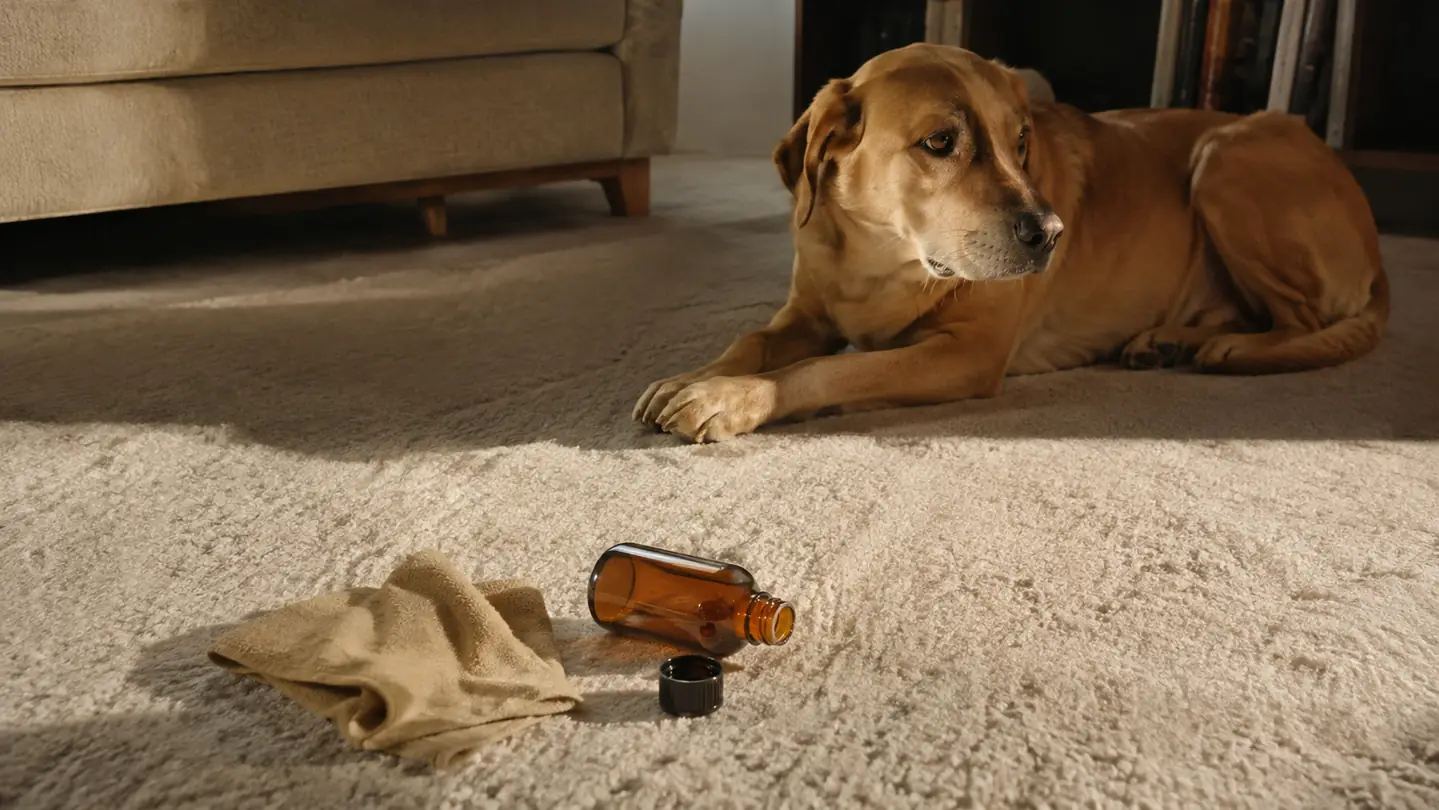
Biscuit is a seven-year-old beagle mix who weighs about twenty-eight pounds and has never met a piece of food she did not want. Pepper is a nine-year-old gray domestic shorthair, indoor only, picky about his water, and particular about where his bowl sits on the kitchen floor. Between the two of them my carpets get more testing than the average Fresno hallway, and the thirty-two ounce bottle of Rocco & Roxie Supply Co. Enzyme Stain and Odor Eliminator has been on my laundry shelf through most of it.
Here is what I would tell a neighbor over the fence, and it is the reason I wanted to write this instead of leaving a star rating and moving on. This product does a real job, and the job is narrower than the surface list on the back of the bottle suggests. It breaks down the organic material in a pet mess when the liquid can reach that material and stay wet on it long enough to finish the reaction. It does not reach into a soaked carpet pad. It does not undo a mark that was set by the wrong cleaner three months ago. And it does not stop a cat from using the same corner again if the material under the carpet still smells like the last time he used it.
The Quick Verdict
Effective on fresh urine, vomit and drool on carpet, upholstery and hard floors, provided you give it contact time and let the area dry completely. Not a rescue for soaked padding, set-in marks, or a pet that has already decided where it wants to go.
Amazon Check Today's Price →The bottle I replace before it runs out
Thirty-two ounces, chlorine free, color safe, and it has handled every fresh pet accident my carpet has taken. Better to have it on the shelf before the next one than to be driving to the store at nine at night.
Amazon Check Today's Price on Amazon →How I've Used It
The first thing I tried, before this bottle, was a general carpet spotter I already had under the sink. It lifted the color of the mess and left the smell, and by the third day the patch was faintly announcing itself whenever the furnace came on. That is how I learned the difference between lifting and breaking down. The spotter did its job. Its job was just not the job I needed done.
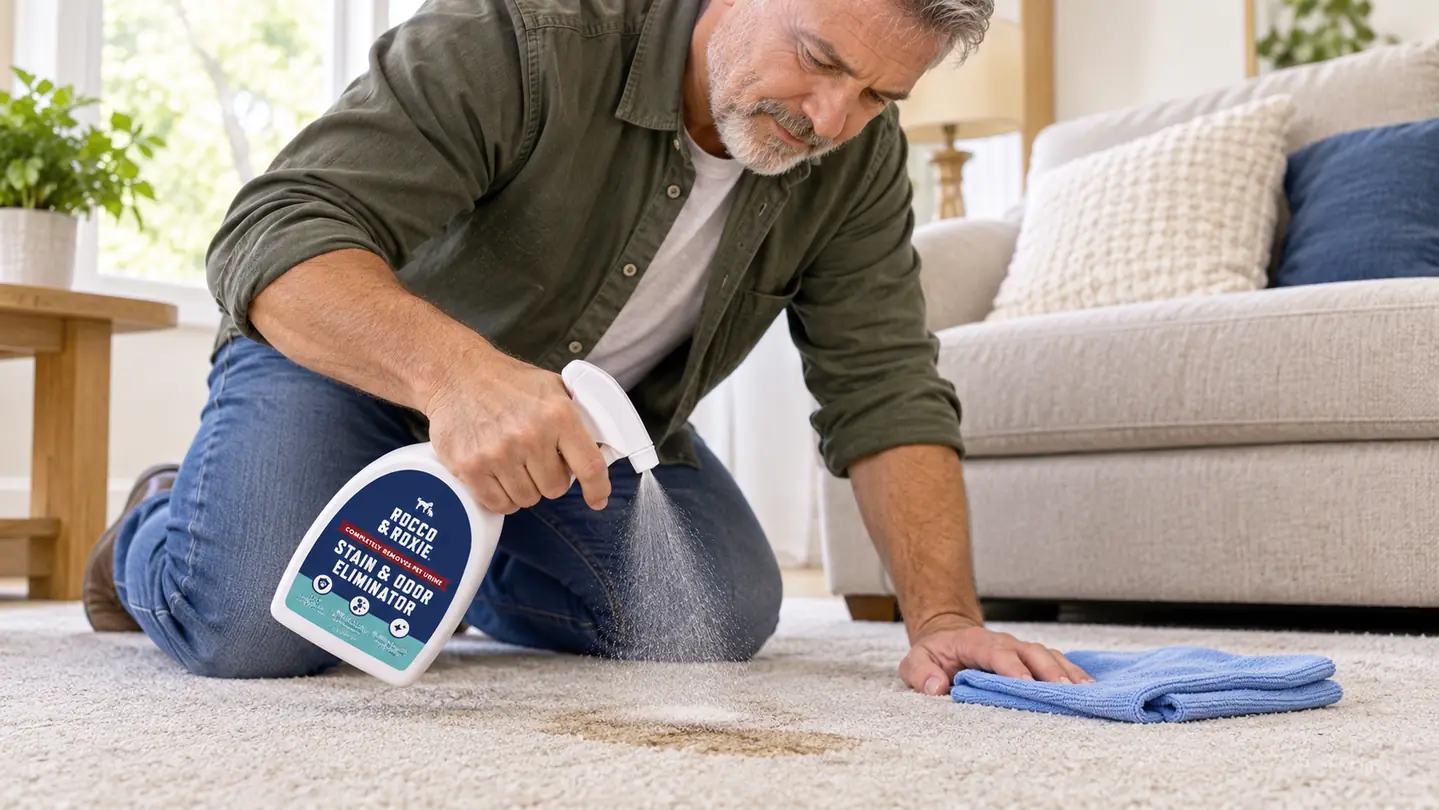
The first real test with this bottle was a food related accident. Biscuit got into something she should not have and left a patch on the living room carpet about the size of a dinner plate. I applied the cleaner generously over the whole patch and past the edge of it, gave it the contact time the directions ask for, blotted up what lifted, and left a fan pointed at the area for the rest of the day. By evening I could not find the spot with my eyes or my nose. That is the best case for an enzyme product, and this one handled it without a second application.
Since then it has gone on cat vomit, drool spots on a sofa cushion cover, a tracked-in mess near the back door, and the concrete in the garage where the dog crate sits. The label lists carpets, floors, furniture, clothing, litter boxes and kennels, and in a house with one dog and one cat that list has held up. It also states the formula is chlorine free and color safe, which is the reason I was willing to use it on a washable cushion cover and not only on a rug I could carry out to the curb if it went wrong.
The bottle is thirty-two ounces, about two pounds, and roughly ten inches tall. It stands upright on a shelf above the washer next to the detergent. That sounds like a small detail and it is not. The products I have to hunt for in a cabinet are the ones I end up not using, and the ones I use are the ones that live where the mess happens.
The other thing that changed my results had nothing to do with the formula. Apply wider than the mark. Urine travels further than the wet patch and further than the visible ring, so if you stop at the ring you have cleaned the middle and left the perimeter, and the perimeter is what a nose finds three days later. Then keep the area damp for the full contact time. If it starts to dry before the time is up, add a little more.
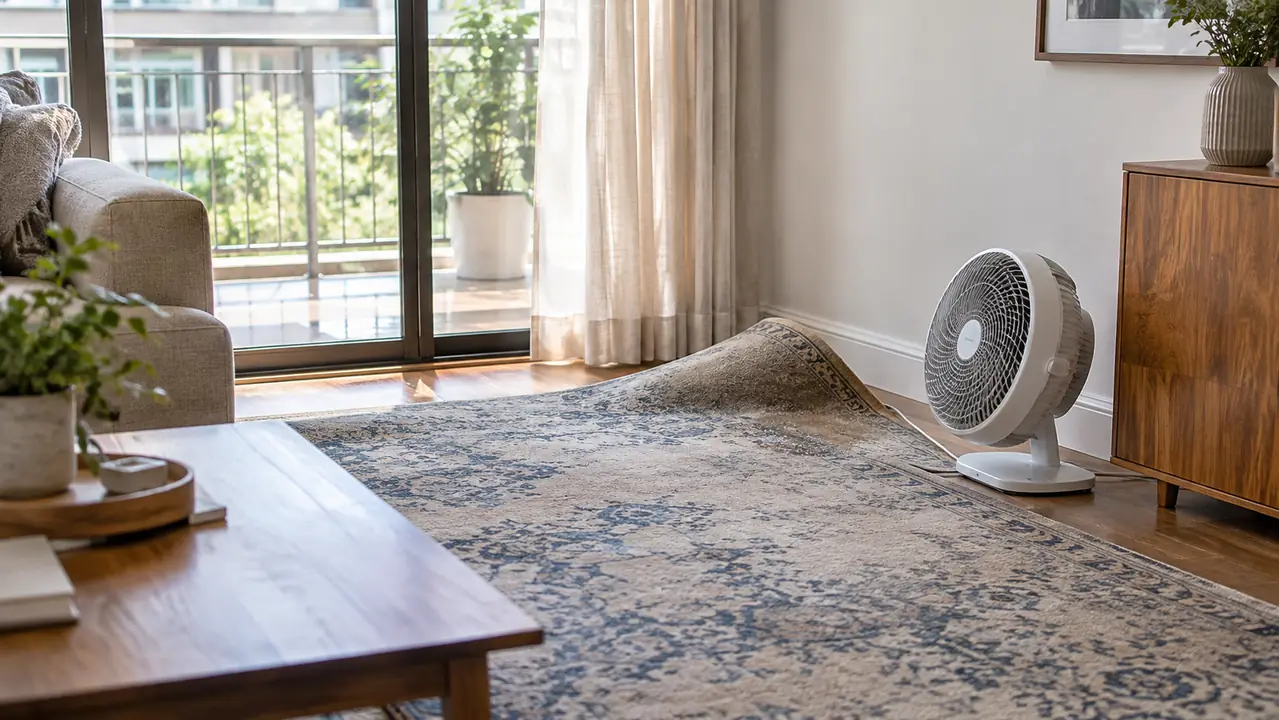
Then blot with a clean cloth, let it air dry with a fan, and leave it alone. Do not walk on it, do not put the rug back over it, do not close the door on it. Drying is the last stage of the process and stopping before it is the same as stopping halfway. None of this is unique to Rocco & Roxie Supply Co. It is how enzyme chemistry behaves in a carpet, and it is the difference between a bottle that works and a bottle that earns a one-star review for being useless.
What Enzymes Actually Do
An enzyme cleaner is not soap. Soap lifts and carries. Enzymes are proteins that break specific chemical bonds, and in a pet mess the bonds that matter belong to uric acid, urea, and the proteins and fats in whatever came up. Uric acid is the one that keeps announcing itself after everything else is gone. Its crystals hold onto carpet fiber and reactivate when the air in the room changes, which is why a spot that seemed handled in March can introduce itself again in July.
That is also why a general carpet shampoo can make a urine mark invisible and leave the smell behind. Detergent goes after visible residue. It does not necessarily go after the compound your nose keeps finding. The bottle is formulated for pet urine and feces specifically, and the surface list runs from carpet to litter boxes to kennels, which is the range where pet mess actually lands in a two-animal house.
The part no label says out loud is that the reaction is not instant and it is not finished when the stain disappears. The enzyme has to stay in contact with the material long enough to work, and then the area has to dry, because the drying is part of how the residue leaves. I have watched people apply, wait a minute, blot, and decide the product is worthless. They cleaned with the blotting cloth.
Fresno gives you a free test of this every summer. In July the house closes up and the air conditioner runs all day, and any spot that was never fully broken down starts to make itself known by mid afternoon. I had one in the hall that I treated in April with something cheap and thought was gone. It came back the first hot week. The second time I used this bottle, kept the area damp for the full contact time, and let it dry with a fan for a day and a half. That spot has not returned through two summers since.
It is worth saying plainly that this is not bleach and it is not ammonia. Bleach kills what sits on the surface and does nothing for the uric acid crystals, and ammonia based products smell enough like urine that some pets treat the spot as a marked location and return to it. Both are the reason people give up and call a carpet company. If you have already used either one, the enzyme has less to work with, but it is still the right second step.
What Enzymes Cannot Do
Three limits matter, and none of them are printed on the bottle.
First, enzymes only work where the liquid reaches. If urine went through the carpet and into the pad, treating the surface treats the surface. The pad stays loaded and keeps feeding odor upward into the room whenever it warms up. I have seen owners put four rounds of a good product on top of a carpet that needed a section of pad replaced, and no cleaner was ever going to win that one. The liquid has to get to the material, and the material was under the carpet.
I found this out the hard way in the hallway, where a spot had gone through a berber carpet and into a half inch pad. I had treated the surface three times over a week, and the room still smelled when the sun hit the window in the afternoon. When I finally pulled the carpet back at the corner, the pad underneath was dark in a patch about the size of a salad plate. That was the whole answer. No amount of surface product was going to reach it.
Second, they need moisture and time. Apply and blot thirty seconds later and you have mostly cleaned with the cloth. Apply, walk away, let it sit, blot, and air dry, and the same bottle gives a different result. Heat is not a shortcut. A hair dryer on high can set a mark the cleaner had already lifted, and then you have a stain no enzyme product will touch.
Third, enzymes are not for everything. Grease, ink, dye, mud, rust and scorch marks are not enzyme problems. Neither is a mark already set by a hot water extraction or by an ammonia based product, because the fiber has changed and there is less of the original material left to break down. If you have already tried something harsh, say so before you buy another bottle. The honest answer may be that the carpet is done.
The Cat Part, Which Is Where Most People Get Hurt
Pepper has a litter box in the laundry room and, for reasons known only to him, a preferred spot on the tile at the end of the hall that he uses when the box is not to his standard. Enzyme cleaner handles the tile. It does not handle the reason. If the grout has taken odor, he can still smell it at a level I cannot, and cleaning the top of the grout does not change his mind about the corner.
The grout was the tell. Tile wipes clean and looks fine, and the grout between the tiles holds what the tile does not. I scrubbed that grout line with a brush and this cleaner twice before I understood that I was treating the top of a sponge. The smell was coming from below the surface of the joint, and the cleaner was doing honest work on the part it could reach.
This is the gap between expectation and result I saw most often at the front desk. People buy an enzyme product because they want the behavior to stop, and the product removes the evidence. Removing the evidence does help, because a cat returning to a spot is usually responding to residual scent. But if the scent has soaked into grout, baseboard, tack strip or pad, the surface treatment is incomplete and the behavior returns within a week.
The honest version is that this bottle is one half of a two part job. Clean the surface properly, then deal with whatever the surface sits on. In my house that meant pulling the carpet back and replacing a section of pad, and after that the corner stopped being interesting. The cleaner did its part before that and did it well. It just could not do the part that belonged to a knife and a new piece of pad.
Where It Annoyed Me
The scent. It is listed as Original and it is noticeable while the area is wet. It fades as the carpet dries and by the next morning I cannot find it, but during the drying window you will know something was applied, and if you are sensitive to fragrance that window feels long.
Speed. Nothing about this is fast. Apply, wait, blot, air dry is most of a day for a serious spot. If you want the carpet dry in twenty minutes, this is the wrong product, and a surface wipe is a different job with a different tool.
Usage rate. A large soaked area drinks the bottle. Thirty-two ounces goes much further than I expected on small spots and not far at all on a big one, so I keep a second bottle under the sink rather than getting caught short on a Saturday night.
Upholstery is where I would spot test first. A washable cushion cover came out fine. A structured sofa arm with a lot of filling is a different situation, because the material has to get wet for this to work and wet filling dries slowly in a closed house. That is not a flaw in the cleaner. It is a fact about upholstery.
What I Liked
- Breaks down urine residue rather than covering the smell, when the liquid can reach it
- Label covers carpet, floors, furniture, clothing, litter boxes and kennels
- Chlorine free and color safe, so washable fabrics are fair game
- No propellants and no hazardous residue listed on the label
- Thirty-two ounce bottle handles a lot of small accidents
Where It Falls Short
- Needs long contact time and full air drying, so it is slow
- Cannot fix urine that has soaked into the pad or subfloor
- Scent is noticeable while the area is wet
- A large soaked area uses a lot of product
- Will not stop a pet returning if the material underneath still smells
One generous application, a full day of drying, and the patch stopped announcing itself every time the room warmed up.
Who This Is For
Households where accidents are occasional rather than constant, and where the mess lands on carpet, tile, hardwood, or something you can put in the washing machine. A puppy in the middle of house training, a senior dog with less warning than she used to have, a cat with a box in a spare room, a kid, a guest who brings a dog. That is the profile this bottle fits, and it fits it well.
It also fits people willing to follow a process. Apply generously and past the edge, wait, blot, dry, repeat once if the spot is stubborn. Rocco & Roxie Supply Co. has made a product that rewards that patience. If you will do the steps, this is one of the better bottles for the job and it earns the shelf space it takes up.
Who Should Skip It
Skip it if the smell returns whenever the room warms up. That is a pad and subfloor problem and no bottle on the shelf solves it. Skip it if the mark is grease, ink, dye or rust, and skip it if you have already treated the spot with an ammonia based cleaner, because you changed the chemistry and there is less left for the enzyme to work on.
Skip it if you want a fast wipe and a dry carpet in ten minutes. Skip it if you are not going to give it the contact time and the drying window, because applying and blotting immediately is the most common way people decide enzyme cleaners do not work. The product is not failing in that scenario. It was never given a chance to start.
If your floors take the hits, keep this on the shelf
Thirty-two ounces, chlorine free, color safe, and built for urine, feces and the residue both leave behind on carpet, upholstery, tile and kennels. Read the application directions before the first spill, not after.
Amazon Check Today's Price on Amazon →