
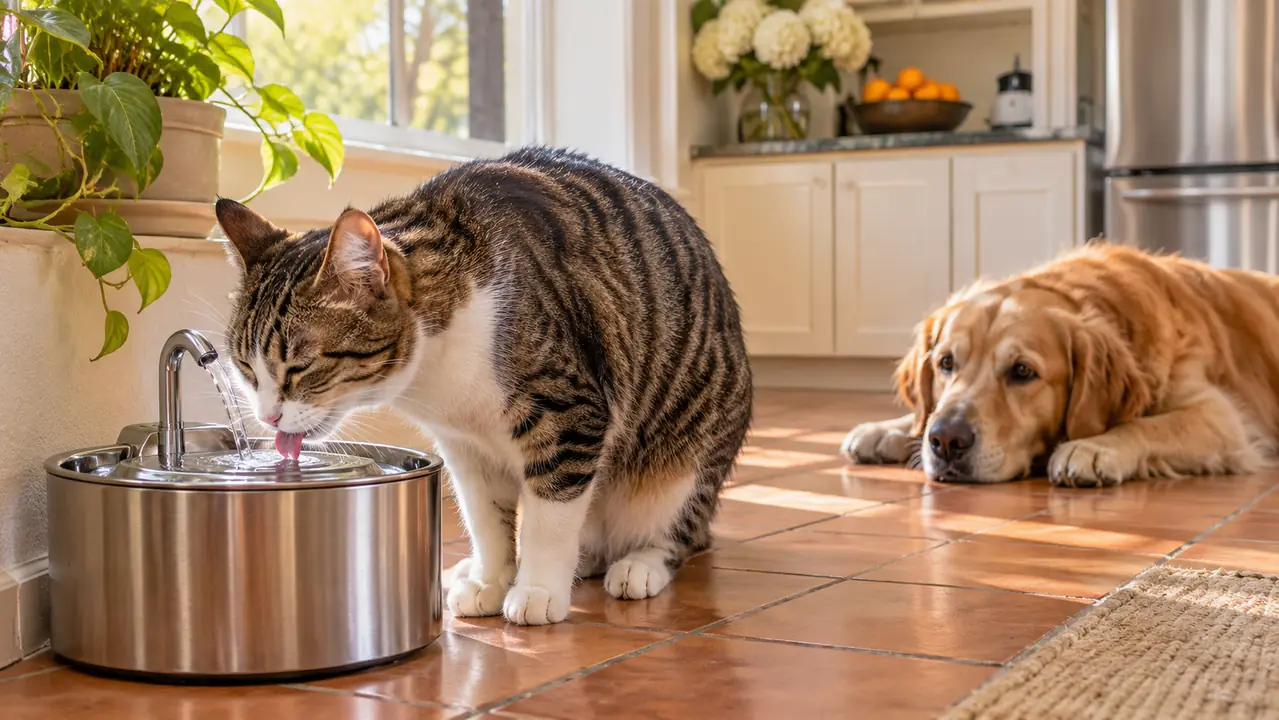
Pepper is nine, gray, and built like a small loaf with opinions. He ignored the last plastic fountain I brought home for about a day, then drank from the Neareal stainless steel fountain like I had finally gotten my act together. I'm Marisol Duarte. I spent 22 years behind the front desk at a veterinary clinic in Fresno, California. Now I live with my husband Ray, a seven-year-old beagle mix named Biscuit, and Pepper. I have watched a lot of owners buy a fountain because it looked cute, then quit cleaning it because it was a pain. This is not a beauty contest. It is a comparison of the two choices I see most in a dog-and-cat house: the Neareal stainless steel fountain and a standard plastic fountain.
Short answer: if you want the fountain that is easier to keep clean and your cat will drink moving water, the Neareal is the one I would hand you. It is 304 stainless steel, holds 108 ounces, or 3.2 liters, and runs on a 5-volt cord. If your budget is tight, your cat is skittish, or you need something you can move with one finger, a plastic fountain still makes sense. I will show you where each one earns its spot on the floor, including the places where plastic wins.
| Neareal Stainless Steel | Plastic Fountain (PetSafe Drinkwell) | |
|---|---|---|
| Material | 304 stainless steel body | Plastic body |
| Capacity | 108 oz / 3.2 L | Varies by model, check the label |
| Filtration | Quadruple filtration system | Typically a single filter |
| Cleaning | 304 steel tolerates high-temperature cleaning | Plastic can scratch and hold odors over time |
| Weight | 1.7 pounds | Often lighter |
| Upfront cost | Higher upfront cost | Lower upfront cost |
| Warranty | 18 months | Varies by brand |
| Replacement parts | Filters and parts through Neareal | Widely stocked for common models |
| Pet acceptance | Pepper drank from it on day one | Some cats take to plastic faster |
Where Neareal Wins
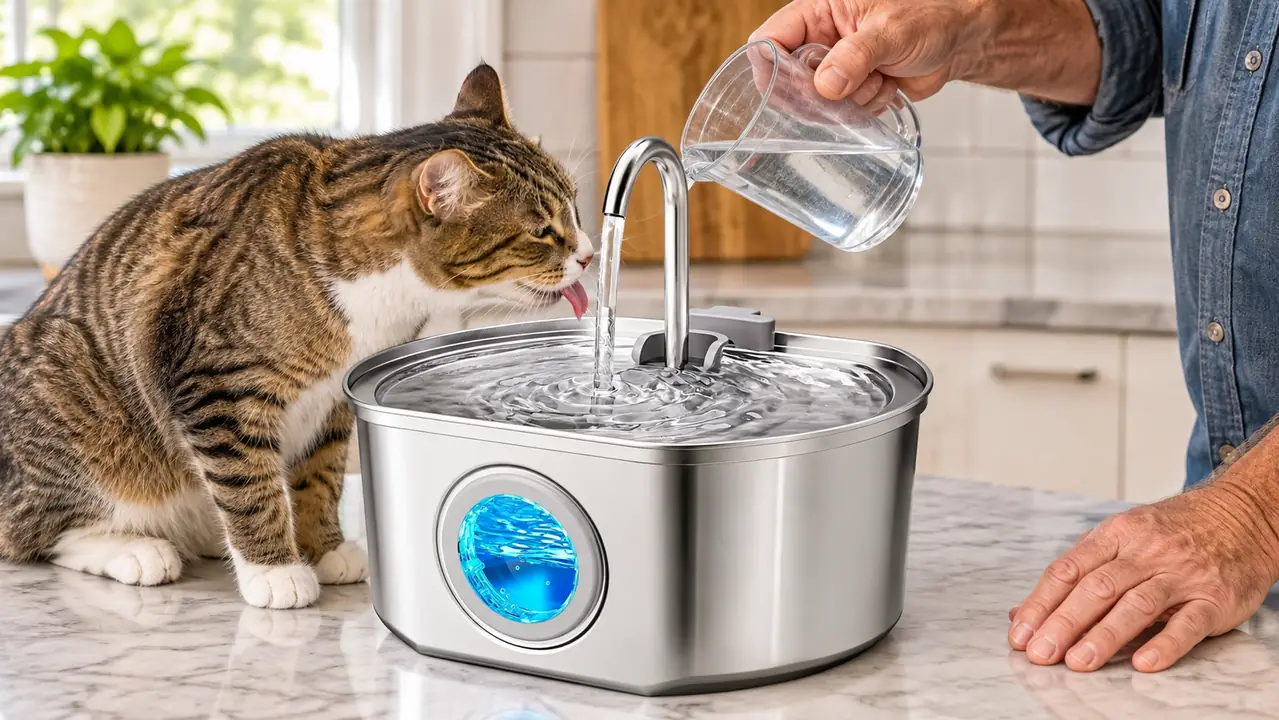
The first thing I noticed is that the Neareal does not hold onto smells. Plastic fountains get tiny scratches. Water sits in those scratches. A month later you scrub a bowl that still smells faintly like the fishy cat food your cat ate for dinner. The Neareal is 304 stainless steel, which the listing says is corrosion resistant and can handle high-temperature cleaning. I am not a chemist. I am a person who has washed a lot of pet bowls. Stainless steel wipes down and stops smelling like the last thing that was in it.
The second win is capacity. The Neareal holds 108 ounces, or 3.2 liters. In a house with Biscuit, who drinks like she has been walking across the Sahara, and Pepper, who likes a fresh-tasting bowl, that means fewer refills. The fountain is 9.17 inches long, 7.56 inches wide, and 6.77 inches high, so it fits on a kitchen mat without taking over the room. It also has a quadruple filtration system. I change the filter on a schedule because that is the whole point of a fountain. If you are not going to change the filter, buy a plain bowl and save yourself the trouble. The 18-month warranty is a reasonable safety net for a product that runs all day.
Where Plastic Fountains Win
Plastic wins on the things you notice at checkout and on moving day. It is lighter. The Neareal is 1.7 pounds, which is not heavy, but plastic is often lighter still. If you move the fountain between rooms, or you have a cat who likes to shove things, that matters. Plastic also costs less upfront. I am not going to pretend that does not matter. A plastic fountain is the easier yes when you are not sure your cat will use a fountain at all.
Plastic also wins on parts. The common plastic models, including the PetSafe Drinkwell I used for comparison, have filters and replacement pieces on the shelf at the pet store. That is a real convenience. When something cracks, you can often fix it that afternoon. The Neareal carries an 18-month warranty, which is a point in its favor, but it is still a specific product from a specific brand. If you want the fountain you can patch together on a Saturday, plastic is the lower-drama choice.
The fountain Pepper chose over the plastic one
Neareal's 304 stainless steel body, 108 oz / 3.2 L capacity, quadruple filtration, and 18-month warranty. If you are tired of scrubbing a plastic bowl that still smells like last week, start here.
Amazon See the Neareal Fountain on Amazon →How I Compared Them
I did not run a lab test. I ran a house test. Pepper is nine, male, gray, indoor only, and picky about water. Biscuit is seven, female, a beagle mix, about 28 pounds, and convinced that any bowl is her bowl. I put both fountains in the same spot on the kitchen tile, one at a time, and refilled them the same way. I washed them on the same schedule. I watched who drank, when they drank, and how much water ended up on the floor.
I started on a Saturday in July, partly because I had the morning free and partly because a hot, dry Fresno afternoon tells you quickly whether an animal is actually drinking or just sniffing out of habit. I kept a notepad on the counter and wrote down the refill time each morning at seven, before Biscuit went out and before Pepper started his rounds. Two weeks on one fountain, then I switched. That notepad turned out to be more useful than anything I thought I already knew about my own animals.
Fresno is hot and dry in the summer. That is not a small detail. When the house is warm, a fountain earns its keep because the water moves and stays cooler than a still bowl. I also paid attention to the annoying parts. How hard is it to take apart? Does the cord get in the way? Does the fountain walk across the floor? Does the cat approach it or treat it like a trap? Those are the things that decide whether a fountain stays plugged in after the novelty wears off.
The Cleaning Difference
This is where the materials matter more than the marketing. Plastic is not evil. It is just softer than stainless steel. It scratches. Once it scratches, it holds onto a thin film that you can feel with your finger. You can scrub it, and you should, but you are fighting the surface. The Neareal's 304 stainless steel body is harder and does not develop that same cloudy film as quickly. I still wash it. I just do not have to scrub like I am trying to erase a mistake.
I started with the same routine I had used on the plastic fountain: a bottle brush, hot water, and a splash of white vinegar. On the plastic, that routine never quite reached the curve where the pump housing sits, and I would find a film there the next morning. On the Neareal, the same brush in the same five minutes got everything I could touch with a finger. The body is a simple stainless steel shape, so there are fewer corners for anything to hide in. That does not make it self-cleaning. Nothing is. But the job is shorter, and in my house the difference between a five-minute cleaning and a ten-minute cleaning is the difference between doing it on a Tuesday and putting it off until the weekend.
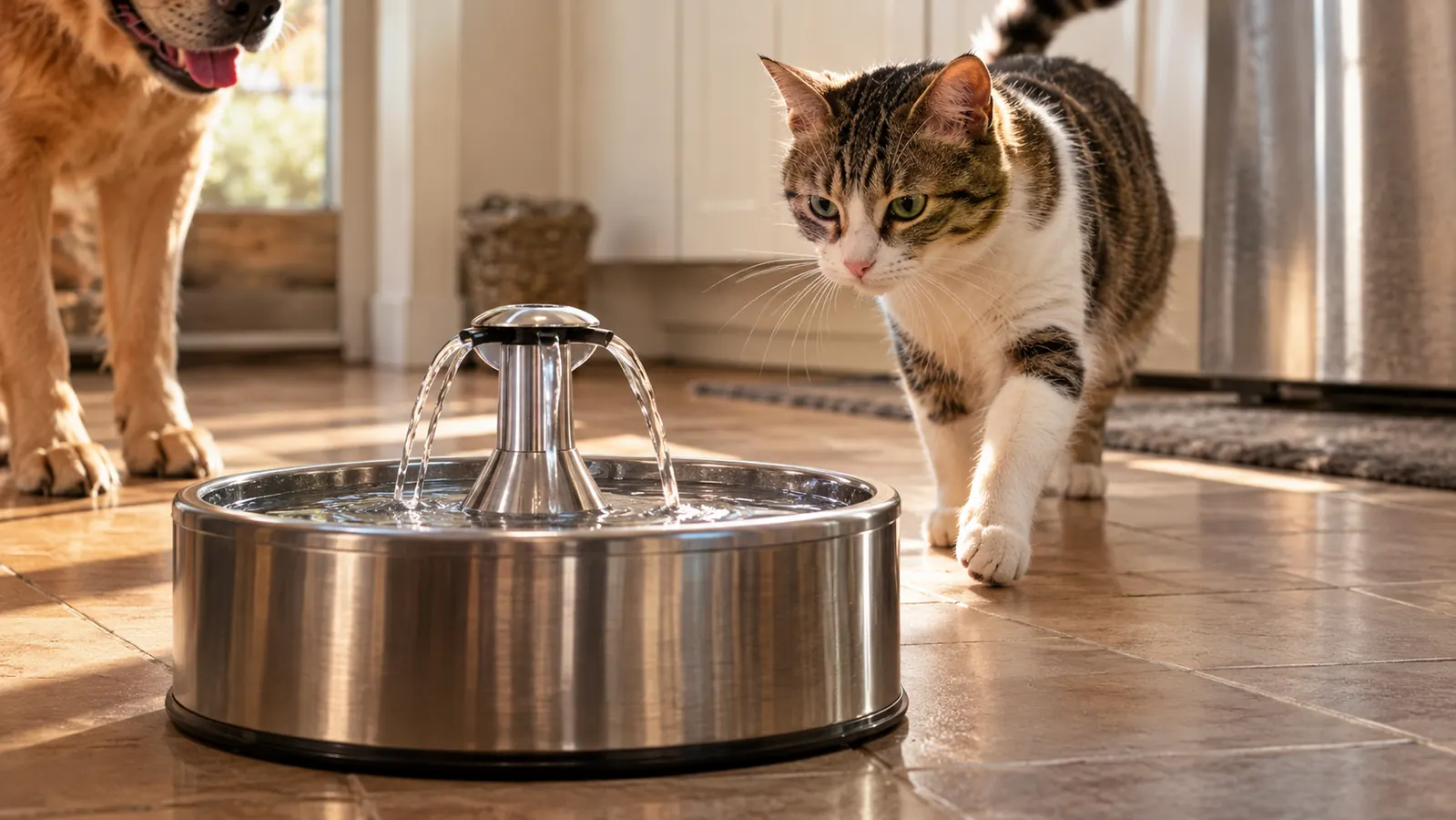
Pepper drank from the Neareal on day one. The plastic fountain sat full for three days. That is the whole review in two sentences.
What Pepper and Biscuit Did
Pepper is the reason I care about filtration. He is nine, and he has opinions about water the way some cats have opinions about wet food. He sniffed the Neareal, watched the water move, and drank. He did not drink from the plastic fountain until the third day. That is not a scientific result. It is one cat. But it is my cat, in my kitchen, and it is the reason the Neareal stayed plugged in.
Biscuit is less subtle. She is a beagle mix, so she investigates with her nose and then her tongue. She drank from both fountains. She also tried to steal Pepper's food while he was drinking, because she is Biscuit. The Neareal is 1.7 pounds, so she could nudge it, but the footprint is stable enough that she did not send it across the floor. If you have a dog who treats every bowl like a toy, put the fountain in a corner or on a mat. That is true for any fountain.
Filters, Capacity, and the Stuff You Relearn Every Month
The Neareal uses a quadruple filtration system. That is the phrase in the listing, and I am repeating it because it is the feature you are paying for. A fountain without filtration is just a bowl with a motor. The filter is what keeps the water from tasting like the inside of the fountain. I check mine every couple of weeks and change it on the schedule. If you have ever wondered why your cat stopped drinking from a fountain, the answer is often a filter that should have been changed a week ago.
I put a strip of blue painter's tape on the side of the Neareal on the first morning so I could see what a normal day of drinking looked like. With both animals using it, the level dropped about a third of an inch by evening, and I could top it off once instead of twice. The plastic fountain I compared it to needed more attention, partly because the bowl was smaller and partly because plastic is harder to get truly clean. The Neareal holds 108 ounces, or 3.2 liters. If you have a dog and a cat, that is not a luxury. It is the difference between a fountain that keeps up and one that runs dry while you are at work.
The Cord, the Counter, and the Learning Curve
The Neareal is corded electric and runs on 5 volts. That is a low-voltage cord, but it is still a cord. You need an outlet near the fountain, and you need to keep the cord where a cat cannot turn it into a toy. I ran mine along the baseboard and put a mat over the low spot. That is not a product flaw. It is just part of living with a fountain. If your kitchen has no outlet near the floor, measure before you buy.
The plastic fountain I compared it to had its own cord and its own quirks. Plastic is lighter, so it moved more when Biscuit bumped it. The Neareal is 1.7 pounds and stayed put better. Neither one is silent. Moving water makes noise. If you need absolute quiet, a fountain is not the right purchase. I noticed the Neareal more in the first week and less after that. That is how most household sounds work.
Who Should Buy Which
Buy the Neareal if you have a cat who will drink moving water, you want a fountain that is easier to clean, and you are willing to change a filter on a schedule. It is also the better pick if you have a dog who shares the water, because the 108-ounce capacity and the stainless steel body hold up to more traffic. Ray, who claims not to be a cat person in the way that people who claim not to be cat people never are, noticed the change before I said a word. He said the water looked cleaner. He meant clearer, and he was right. That is the sort of thing you notice in a kitchen you walk through forty times a day. The 18-month warranty is a reasonable safety net. I would not call it a lifetime purchase. I would call it the one I would buy again for this house.
Buy a plastic fountain if the upfront cost is the deciding factor, if you need something light to move around, or if your cat is nervous and you are not sure a fountain is going to work. Plastic is also the easier choice if you want to walk into a pet store and buy replacement parts that day. There is no shame in starting there. The only mistake is buying a fountain you will not clean. A dirty fountain is worse than a plain bowl.
The one I would buy again for a dog-and-cat house
The Neareal stainless steel fountain: 304 stainless steel, 108 oz / 3.2 L, quadruple filtration, 5-volt cord, 18-month warranty. If Pepper approves, that is a real test.
Amazon Check the Neareal Fountain on Amazon →