
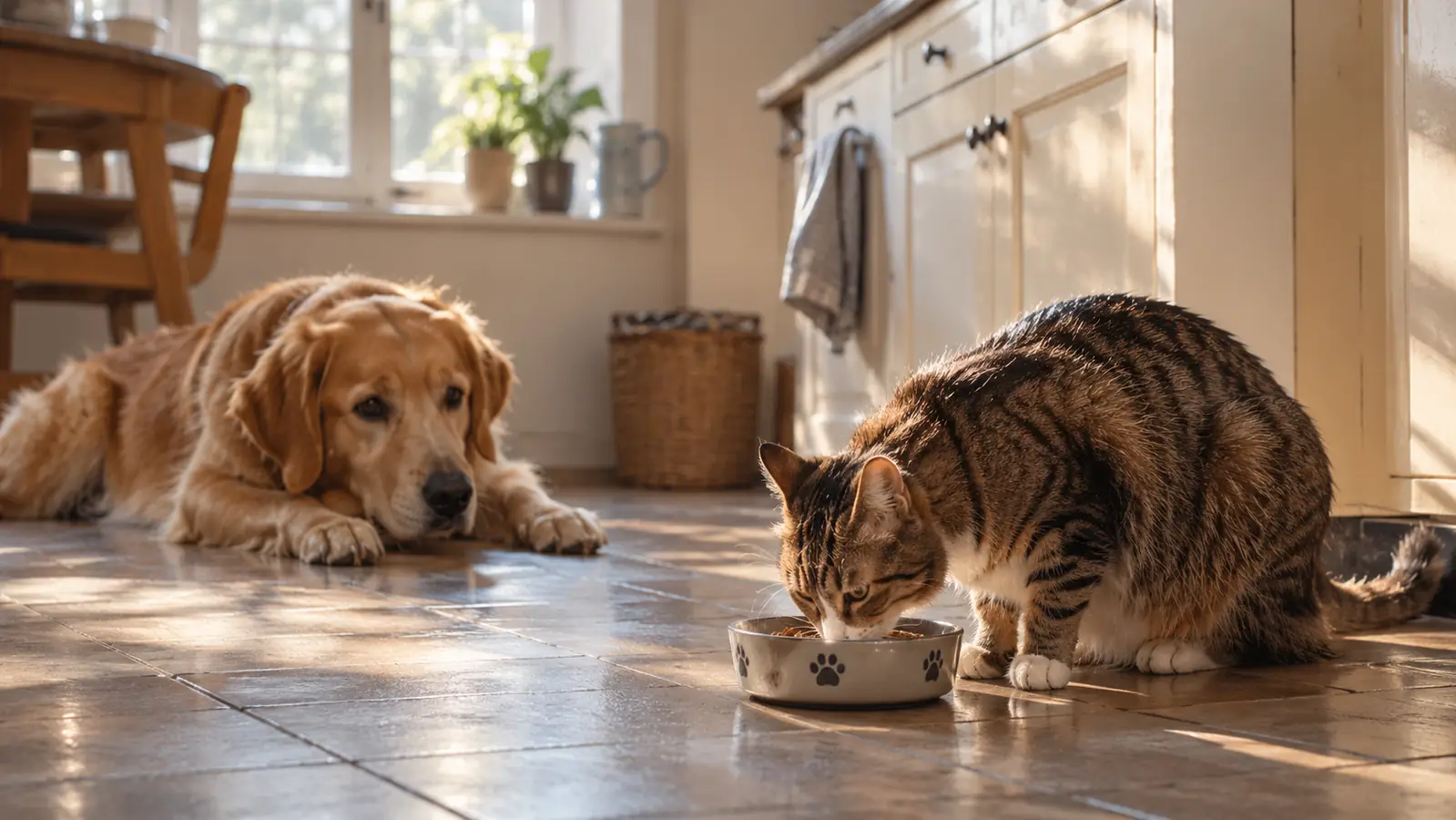
Biscuit is seven, twenty-eight pounds of beagle mix, and she has never once felt bad about anything she ate. Pepper is nine, eleven pounds, gray, indoor only, and eats the way a cat does on a hot afternoon: three bites, a walk around the kitchen, three more bites. For years I stood in the doorway and refereed. Biscuit finished her own bowl in about ninety seconds and then shouldered Pepper off his. Twenty-two years at a veterinary front desk and I still could not out-referee a beagle at seven in the morning.
I tried what people try. I fed Pepper up on the counter until Ray's knees and Pepper's age made that a bad idea. I shut him in the laundry room and he cried and scratched the paint off the door frame. I split his meals into four servings and set alarms on my phone. None of it fixed the actual problem, which was two animals in one kitchen with access to one bowl. What fixed it was a feeder that opens only for the cat with the right microchip. The SureFlap SureFeed Microchip Pet Feeder is that feeder, and eight months in, here is the sequence that works.
One bowl, one cat, and a lid the dog cannot argue with
The SureFeed reads the microchip your cat already has and opens for him alone. Battery powered, no cord across the floor, and one collar tag in the box if your cat is not chipped.
Amazon Check Today's Price on Amazon →How to Make the Switch, Step by Step
Step 1: Get the chip number, not a guess
Before the feeder comes out of the carton, find out what is actually inside your cat. Pepper was chipped by the rescue years before I met him, and the number I had written on a scrap of paper was missing a digit. I had the clinic scan him and read it off the screen while he sat on the scale. The SureFeed reads 9 digit Avid Secure chips, 10 digit FDXA chips and 15 digit FDXB chips, which covers nearly every cat chipped in this country in the last twenty years. If yours does not match, or your cat was never chipped, the box includes one collar tag that does the same job.
Do not skip the scan. I have watched people spend an entire evening convinced a feeder was defective when the real problem was a transposed digit typed from memory. Write the number on a slip of tape and stick it inside the battery compartment. In two years you will not remember it, and you will be moving furniture or hauling the thing to a pet sitter and you will need it in a hurry.
If you are going the collar tag route instead, check the fit before you trust it. A tag hanging loose on a slim cat will swing out of range, and a tag on a collar that sits too high on the neck reads inconsistently. Two fingers of slack under the collar, tag hanging at the front of the throat, and a quick test to confirm the lid opens every time. Pepper is chipped so I never needed the tag, but I put it on the shelf for a cat-sitting week and it worked fine on a borrowed collar.
Step 2: Set it up on the floor before you introduce it
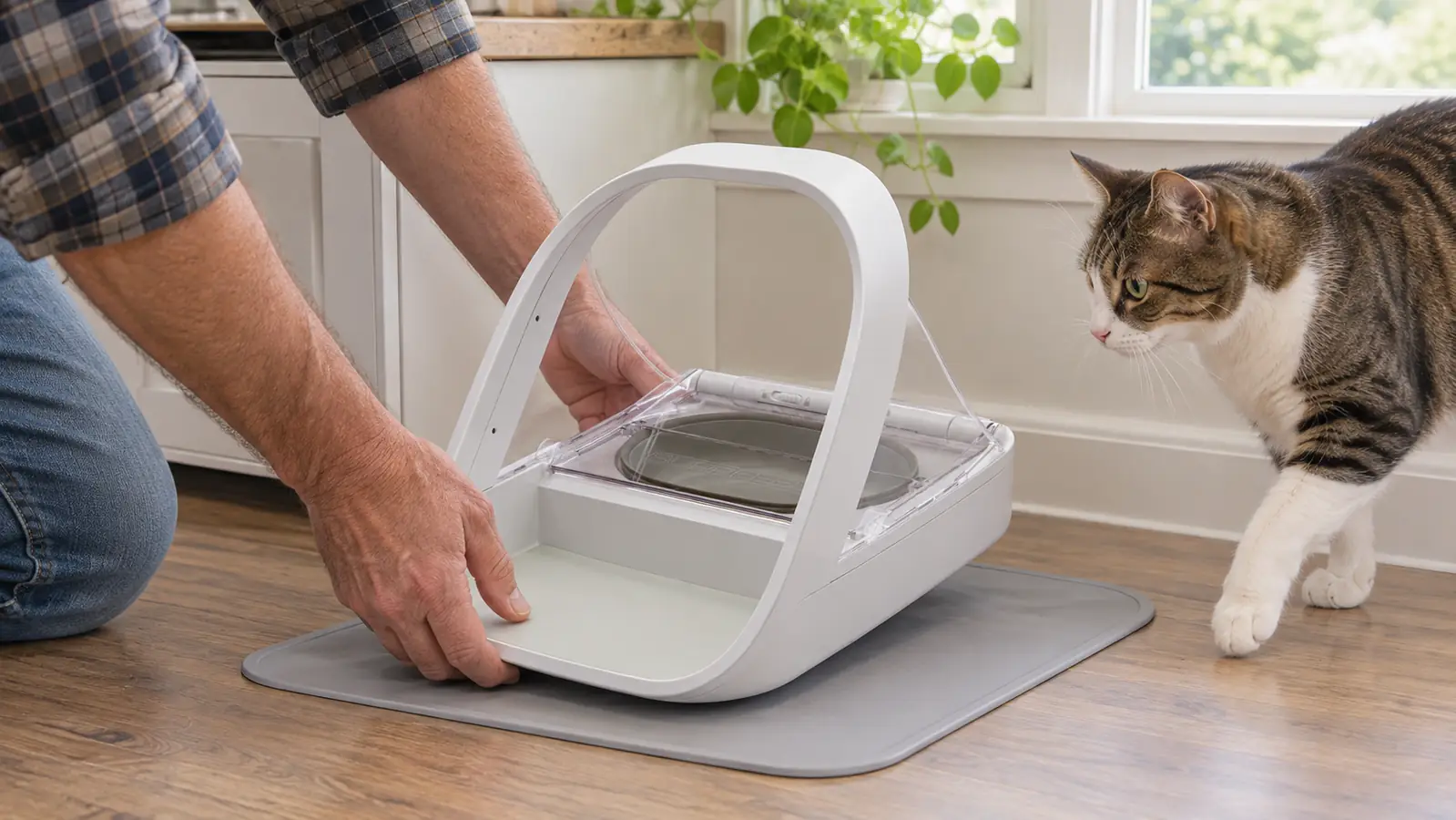
Set the feeder where you intend to keep it, not on the counter and not in a hallway you are about to walk through. It is plastic and it weighs a little over three pounds, and it measures roughly 12.9 by 7.8 by 10.2 inches, so give it a real footprint of floor. A placemat comes in the box. Use it. A cat eating wet food will dribble, and a mat is far easier to rinse than the seam where the floor meets the baseboard.
There is no cord, which mattered in my house because every outlet in this kitchen is in the wrong place. It runs on batteries. The bowl holds 400 milliliters, about 13.5 fluid ounces. That is a full day of wet food for an eleven pound cat and a bit more than a day of dry. Do not top it off like a trough. Fill it to one normal meal, because the entire point is that you control how much the cat gets and the dog gets none of it.
Registering the chip is where people quit. Enter the number, watch the feeder open for the cat, watch it stay shut for everything else, and test it twice before you decide anything. The SureFlap unit stores up to 32 IDs, so a household with more cats than mine is covered, and you can add a second animal later without buying anything. The lid startled me the first time it moved. It is quieter than I expected, more of a soft motor whir than a clack, and the bowl sits low enough that the cat is not reaching up for it.
Step 3: Train the cat first, and keep the dog out of the room
The cat is the one who has to trust this object, so the cat gets trained first and the dog does not get to watch. For the first three days I taped the lid open so Pepper could eat out of an open bowl in a new spot with nothing moving at him. He still circled it twice and looked at me over his shoulder. A nine year old cat does not accept new furniture on the first afternoon, and pretending otherwise is how people end up writing one-star reviews.
Then I took the tape off and sat on the floor six feet away while he ate. The lid opens when his chip is close and closes a few seconds after he backs out. The first close made him jump and leave a bite behind. He came back four minutes later and finished it. By the end of that week he was standing over the bowl waiting for the lid to open like it owed him money.
Give it two weeks before you call it a failure. The cats that struggle are usually the ones whose owners hover with their hands out, or the ones who never got a quiet first attempt with the lid propped. If Pepper had not come around, my next move was to feed him beside the closed feeder and then move the bowl inside, one step at a time. I did not have to do that.
Pepper put on eight ounces in the first two months. Biscuit lost four. Same food, same kitchen, different bowls.
Step 4: Teach the dog that the bowl is furniture
Biscuit found the feeder about eleven minutes after I set it down. She shoved her muzzle under the lid, the lid held, and she sat back and stared at me like I had personally betrayed her. That first refusal did more work than any correction I could have delivered. Do not scold the dog for investigating. Let the hardware say no, and then give the dog something else to do.
What I changed was the order of the morning. Biscuit gets fed first now, in her own bowl, at the other end of the kitchen, with a few extra seconds of attention while she eats it. A dog that has already eaten is a dog that is not conducting an investigation. I also stopped leaving anything edible on the counter, because a beagle who cannot reach the cat's bowl will absolutely go looking for the next best option.
If your dog is the type to body-slam a bowl, watch the first week closely. The feeder is lightweight and it will slide on tile or hardwood. The included placemat helps, and pushing the whole thing into a corner against the wall helps more. A feeder that shifts under a determined dog is a feeder that will eventually get flipped.
Step 5: Hold the routine and keep the bowl clean
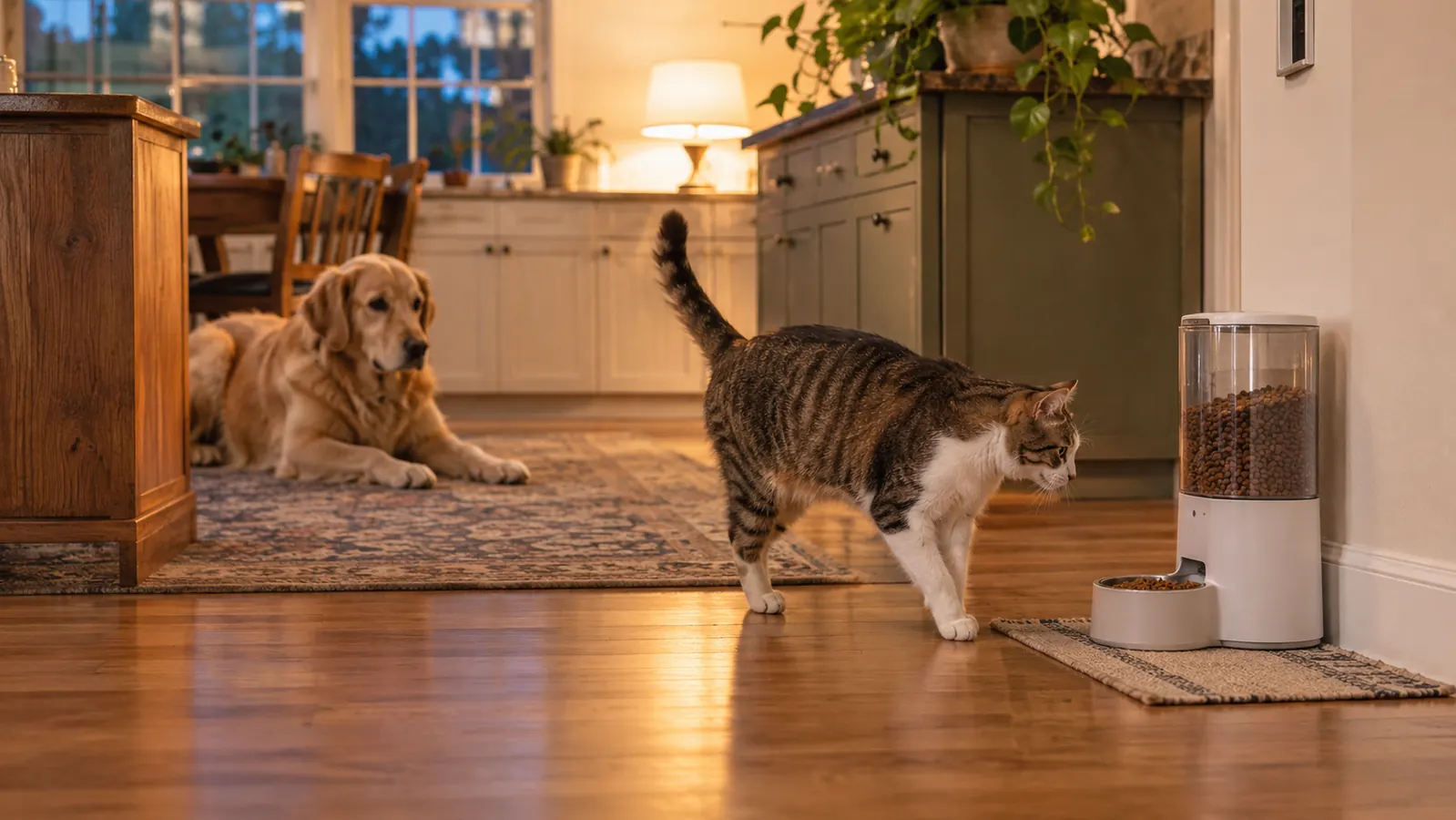
Placement matters more than people expect. Put the feeder against a wall, out of the path between the dog's bowl and the back door, and give the cat a clear approach. If Pepper had to walk past Biscuit to reach his dinner, I would have solved the food problem and created a traffic problem, and the traffic problem would have undone the food problem within a week.
Keep the routine boring. Same spot, same times, bowl rinsed every morning. Fresno summers are hot and dry, and wet food in a lidded bowl turns faster than people realize. A cat will refuse food that has soured, and then you will be back to square one convinced the SureFlap feeder is malfunctioning when it is the food. Wipe the inside of the lid once a week with a damp cloth and let it air dry.
Keep spare batteries in a kitchen drawer. When they run down the lid stops behaving the way it should, and a feeder that stops closing is just a very fancy bowl. I nudge the lid every Sunday to confirm it still holds, which takes two seconds and saves a morning of confusion.
The Parts That Annoyed Me
It is not a small object. On my floor it occupies a corner I used to use for the recycling bin, and I had to move the bin. The listing also states no warranty, which is worth knowing before you buy rather than after. And the lid is one more surface to clean in a house that already has enough surfaces, which is why I built the weekly wipe into my routine instead of pretending I would remember.
More importantly, this feeder guards one bowl. It does not stop a dog from cleaning out a dish you left on the counter, from getting into the trash, or from raiding the litter box. I still had to fix those separately. What it does is remove the daily race at seven in the morning, and that turned out to be the piece that made the rest of it manageable.
What Else Helps
Separate stations, as far apart as your kitchen allows. Biscuit eats in the corner by the back door and Pepper eats against the opposite wall. Two animals eating nose to nose will always negotiate, and the negotiation always ends the same way. Distance is free and it does half the work before the feeder even gets involved.
Feed the dog something that takes longer than ninety seconds. I put Biscuit's kibble in a slow feeder bowl, which added about six minutes to her meal and removed most of the pressure she was putting on Pepper. A dog with a project is a dog that leaves the cat alone. This mattered more in the first month than anything else I did.
And deal with the litter box at the same time. A dog that has been blocked from the cat's food is a dog looking for a consolation prize, and the box is the next room over. A covered box, or a gate the cat can clear and the dog cannot, closes that loop. If you fix only the food, you have fixed half a problem and you will notice the other half by smell.
Eight months in, one cat, zero raids
Battery powered, holds 13.5 fluid ounces, stores up to 32 microchip IDs, and ships with a placemat and one collar tag. It took Pepper about a week to trust it and Biscuit about eleven minutes to give up.
Amazon Check Today's Price on Amazon →