
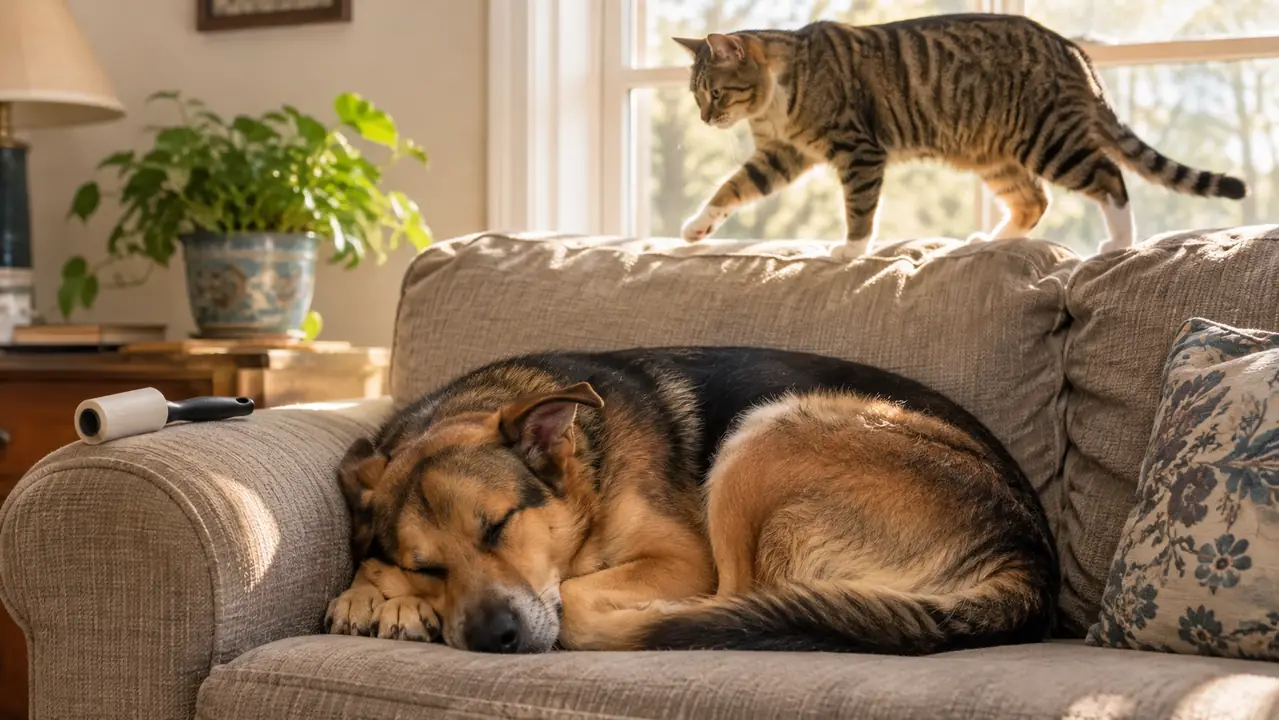
Dog hair and cat hair are two different problems wearing the same costume. Biscuit's beagle shed comes off in short, stiff needles that work their way into fabric like little splinters, and once they are in, they stay in. Pepper's gray hair is lighter and finer and it floats. It lands on the couch after he leaves the room, not while he is sitting there. Attack both with the same sticky sheet and you will pull one of them and smear the other around.
I spent twenty-two years behind the front desk at a veterinary practice here in Fresno, and after food, the question I heard most was how to get the hair off the furniture. My answer has not changed. Use something that lifts hair out of the weave instead of dragging it across the surface. The ChomChom Roller is what sits on my end table now. It is a manual, reusable roller with a brush that does the lifting, no tape, no adhesive sheets, no wires, and it handles both kinds of hair in the same pass. Here is the order I actually do it in, including the parts that took me a while to get right.
The tool that lifts hair out of the weave instead of pushing it around
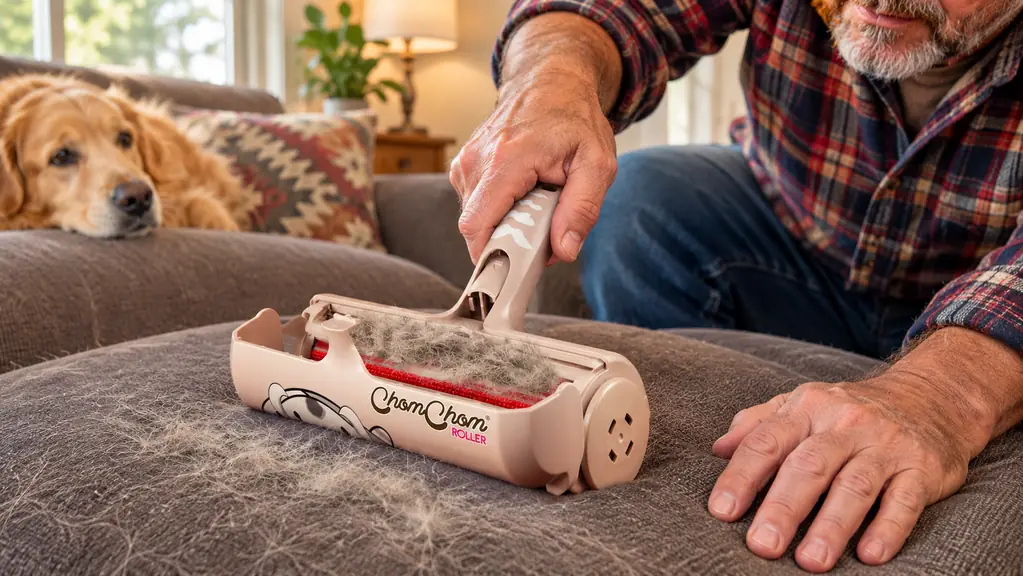
Manual operation, a reusable brush, and nothing to peel or refill. It measures 7.5 by 7.5 by 2.5 inches and weighs 6.4 ounces, so it lives on the end table instead of a closet shelf.
Amazon Check Today's Price on Amazon →Why Tape, Vacuums and Damp Sponges Keep Losing
Sticky sheets work by adhesion. They grab what is sitting on top of the fabric and nothing else. On a tight weave that is maybe a third of the hair. On a loose weave or a textured throw it is closer to none, because the hair has already slid below the surface. You peel a sheet, press it down, peel it again, and the couch looks the same as when you started. Twenty sheets later you are still looking at a gray haze and your hand hurts.
Vacuums pull, which is the right idea, but an upholstery nozzle needs airflow to do anything and a fat couch cushion fights that. The hair woven into the fabric stays put, and the hair on the surface gets moved from the cushion to the floor, where it becomes a second job about ten minutes later.
Damp rubber gloves and damp sponges do work on short hair. They also leave the fabric damp, which is fine in Fresno in July and a poor idea in a house with a cat who will immediately lie on the wet spot. And they stop working the moment the sponge stops being damp.
The ChomChom Roller takes a different approach. It is manual, so there is no motor, no battery and nothing to switch on. You hold it and pull it back and forth. The brush inside works the hair up out of the weave and the motion carries it off the fabric. That is the whole mechanism, and it is the reason it reaches hair that tape cannot touch.
Step 1: Strip the couch down before you touch the roller
Take the cushions off. All of them, including the ones you have decided are fine. Hair migrates. It works into the gap between the seat cushion and the back, and from there it drops into the frame, and if you only clean what you can see, that gap becomes a reservoir that keeps refilling the cushions you just finished.
With the cushions off, run a vacuum hose over the frame and the deck using the open hose with no attachment, to pull up loose hair and crumbs and the cat treats Pepper has knocked back there. Do this first. Roller first and vacuum second means you are doing the vacuum's job with a hand tool and wondering why it takes so long.
Throws and small rugs get shaken outside or vacuumed flat. Anything removable that Biscuit sleeps on goes in the wash. Fresno is dry enough that a line-dried cushion cover is ready in an hour most of the year, which is one of the few favors this climate does us.
Step 2: Test one hidden corner, then stop worrying about it
Turn a cushion over and test on the underside of a back corner, where nobody looks. Any fabric tool can snag a loose weave or pull a thread on delicate upholstery, and finding that out on the seat cushion makes for a bad afternoon. Ten seconds of testing buys you a lot of confidence.
The ChomChom Roller has never pulled a thread on my couch, which is a ten-year-old woven fabric that has survived a beagle and a cat who scratches. I still test every new piece of furniture, because I have been wrong before and the underside of a cushion is a cheap place to be wrong.
If the fabric is velvet, a microfiber with a directional nap, or anything with a raised pattern, test two spots instead of one. Directional fabrics can look different after you work them one way, and you want to learn that before you have done the entire couch.
Step 3: Short, firm strokes, one section at a time
This is the part most people get wrong, and it is why some of them decide the roller does not work. Do not scrub. Do not press down hard and grind. Hold the ChomChom Roller flat against the fabric and pull it back and forth in short strokes, about the length of your hand, with some speed and very little downward force. The brush needs to travel across the weave, not be crushed into it.
Work in sections. One seat cushion is one section. Do the top, flip it, do the other side, then move to the back cushion and then the arms. Arms take longer than you expect because the fabric is usually tighter there and the hair has had longer to settle in.
You will see the hair gather into a line as you go. Keep working that line until it stops growing, then clear the hair off into the trash and start the next section. Doing the clearing between cushions rather than at the very end is what keeps half of it from ending up back on the floor.
Tape takes off the hair that was about to fall off anyway. The brush gets the hair that has already moved in.
Step 4: Get the seams, the corners and the cat's spot
Seams are where hair goes to live. Run the roller along the seam line rather than across it, so the tool can work hair out of the channel instead of pushing it deeper. Same for the piping around the arms and the welt cord on the back cushions.
Pepper has one spot on the left arm of the couch. He has had it for six years. That arm is a different job than the rest of the couch, because the hair there is dense and pressed flat, and it takes three or four passes before the fabric stops looking gray. I do that arm last, after everything else, so I am not dragging loose hair back over the part I just finished.
Corners and the gap between the seat and the back get the edge treatment. Push the cushion back, work the roller into the crease at an angle, and pull out toward you. If the gap is deep, a vacuum with a crevice tool handles what the roller cannot reach, and then the roller finishes the fabric on either side of it.
Step 5: Make it a two-minute habit instead of an afternoon
Couches do not get bad because the tool fails. They get bad because somebody cleans once, hard, and then nothing for three months. Two minutes every other day beats two hours once a season, and it takes far less willpower.
My routine is about as simple as it gets. Cushions stay on. I do the seat, the two arms and the back, in that order, in roughly the time it takes the kettle to boil. Tuesdays, Thursdays and Saturdays, plus any day somebody is coming over. The roller sits on the end table where I can reach it without standing up, which is the only reason the habit stuck at all.
Every few weeks I still pull the cushions and do the frame, and the couch gets a proper vacuuming. But that is maintenance now, not a rescue. There is a real difference between keeping up with two animals and fighting them.
What the Roller Does Not Do
It is a hair tool. It does not clean the couch. Crumbs, grit, the fine dust that comes in off a Fresno afternoon, and anything sticky stay where they are and still need a vacuum. It also does nothing for odor, which is a separate problem with a separate answer.
It is manual, so it takes some arm work. A whole three-cushion couch from stripped down to finished takes me about twenty minutes, and my shoulder notices. On a very deep pile or a heavily matted spot, expect more passes than feels reasonable before the fabric comes back. That is not a defect. It is how much hair was in there.
And it will not reach into a deep crevice between the frame and the deck. No hand tool will. That is what the vacuum hose is for, which is why Step 1 comes before Step 3 and not after.
What Else Helps
A washable throw over the seat cushion, rotated and washed weekly, catches a surprising amount of Biscuit's shed before it ever reaches the fabric underneath. It also means the thing you are laundering is a throw and not a cushion cover with a zipper and a fit to fight.
Grooming is the other half of this. Five minutes with a deshedding tool on Biscuit twice a week in spring puts that hair in a bag instead of on your upholstery. Pepper gets brushed weekly, which he tolerates for roughly ninety seconds, and those ninety seconds are well spent. Hair that comes off the animal is hair you never have to lift out of a weave.
Air matters more than people think. A filter running in the living room cuts down on the fine cat hair that floats and resettles behind you about an hour after you finish. It is not a hair removal tool and I would not pretend otherwise, but it changes how often the couch needs one.
Twenty minutes with the cushions off, or two minutes every other day
The ChomChom Roller is manual, reusable, and built from BPA-free plastic with no wires and nothing to charge. At 7.5 by 7.5 by 2.5 inches, it fits in the gap beside the couch cushion so you will actually reach for it.
Amazon See Current Price on Amazon →